|
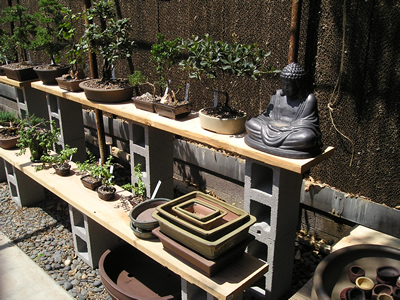
The following information has been provided by the Phoenix Bonsai Society.
Bonsai is an age-old oriental art of growing small trees in pots. Twice upon a time, it originated in China, took shape as an art form in Korea, and blossomed in Japan. However, this live art form has transcended national boundaries and begun to take root in many other Asian and European countries and the U.S. Now growing bonsai has become a lifestyle preferred by a myriad of nature-loving people around the world.
Climate/sunlight
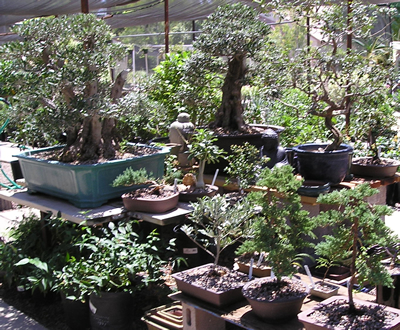
It is a popular misconception that bonsai should be grown indoors as houseplants. In fact, most are hardy trees that need to be grown outdoors in the open. If you bring them inside, it should be for a couple of days.
The best advice is to avoid extremes. In temperate areas, most bonsai can stay outdoors all year. In sunny areas such as California, a partial shade outside is an ideal spot for keeping your bonsai in good shape. So long as you can keep your bonsai exposed to more than a couple of hours of moderate sunlight every possible day, you can keep it in a well-ventilated room for a considerably long time. Moderate sunlight means in California direct morning or late afternoon sunlight, or diffused (filtered or dappled) sunlight.
In cold places like Canada and the north-eastern USA, the trees must always be protected adequately against frost. As long as your tree is well watered, it requires as much moderate sunlight as possible. Any lack of sunlight could be made up for by artificial light such as a Grow Light that has ultraviolet rays.
Watering
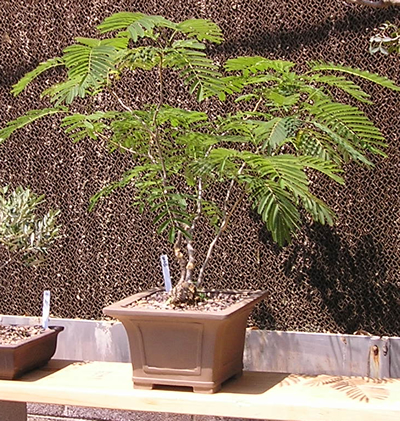
More bonsai die from unsatisfactory watering that from any other problem. Their roots dry out much more quickly in their shallow pots than if they were planted in open ground. Most bonsai can survive, if not thrive, when grown in an inadequate soil without added nutrients. However, if they do not have water they will soon dehydrate and die. If you keep them wet all the time, theirs roots will become rotten and they will be die. So it is ideal to water them when the soil is almost dry. Do not wait until soil dries out completely.
Usually, experienced bonsai growers water their bonsai daily from spring to autumn and sparingly in winter, or ate proper intervals, depending on such factors as temperature, humidity, and wind. However, more practical ways of watering for beginners are to saturate bonsai completely by soaking them in water for 5-10 minutes, with the water level about an inch above the edge of the pot.
Spring and summer - 2 or 3 times a week.
Fall and winter - 1 or 2 times a week.
Care in Winter
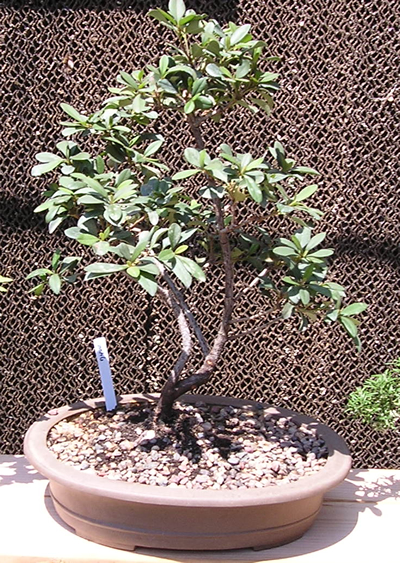
How much winter protection is needed varies from species to species, and depends on the conditions where you live. Generally speaking, protect your bonsai against wind and frost, but do not keep it indoors for longer than a few days because a heated room will not only dehydrate the tree fast, but also break its dormancy into sappy growth. It does need maximum light, so a cold frame or a well-ventilated greenhouse (or a simple plastic house) will make good winter quarters. Alternatively, place your tree underneath its display bench, dropping a clear plastic "curtain" down in front of it to screen off the worst of the weather. Cold winds are particularly damaging to the foliage of evergreens.
Fertilizing
It is essential to feed your bonsai for good growth. If you do not, they may not die but they certainly will not flourish. From spring to fall, it is customary to apply a general, balanced fertilizer. In the fall it is advisable to switch to a fertilizer rich in potassium and phosphorous but low in nitrogen, because it is then that the growth rate slows and they start to become dormant.
It is safe to apply a fertilizer specifically designed for bonsai. If you have no other choice but to use general plant food, you have to pay attention to the main elements printed on the packaging in the order NPK (N for nitrogen, P for phosphorous, and K for potassium). A typical spring or summer formula is in the balanced ratio (for example, 10:10:10 or 15:15:15); an autumn formula in the ration 0:10:10.
Apply the bonsai fertilizer just a little at a time on a regular basis: once a month or every other month.
Pests and diseases
Put your bonsai on an elevated rack to avoid insect infestation. Fortunately, most bonsai trees are not notably susceptible to pests and diseases. However, if a problem should arise, you should recognize it quickly and "nip in the bud". A useful prevention measure is to spray the bonsai monthly, from early spring and through the summer, with a systemic insecticide and fungicide.
Recommended pesticides are: